
NEW EU DISCOVERABILITY STUDY UNDERLINES VALUE OF DIVERSITY, FINDS THAT VISIBILITY IS HAMPERED, RECOMMENDS ACTION
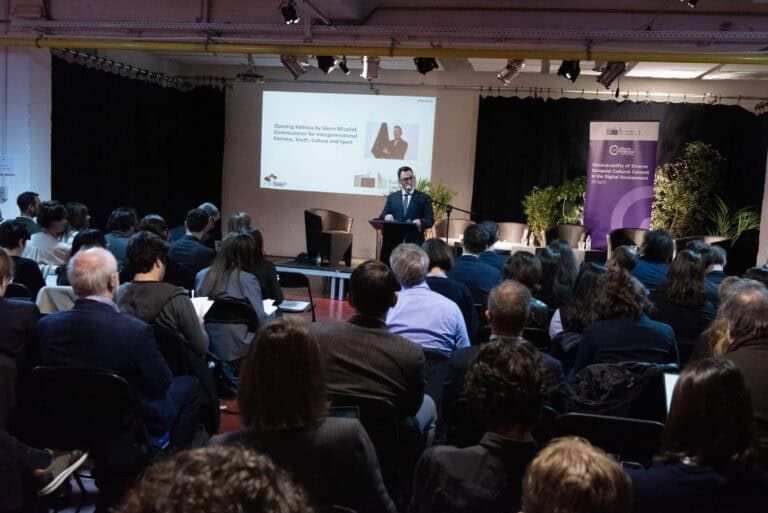
(European Commissioner for Intergenerational Fairness, Youth, Culture and Sport, Glenn Micallef, providing opening remarks at the conference on the discoverability of diverse European cultural content in the digital environment)
Brussels 22nd April 2026,
See our original social media posts: Instagram | LinkedIn | Facebook | X
This week in Brussels, IMPALA joined policymakers, cultural stakeholders, and experts at the European Commission’s conference on the presentation of the study on discoverability of diverse European cultural content in the digital environment.
Commissioned by the EC under the EU Work Plan for Culture 2023–2026, the study assesses the current state of online discoverability of diverse European cultural works (primarily music and book sectors), with particular attention to the role of platforms, curation, and recommender systems, and identifies emerging challenges and areas for policy action. As more people access culture online, discussions highlighted the importance of supporting cultural diversity and ensuring audiences can access a wide range of European works online. Among other recommendations, the study calls for:
- Strengthening cultural curation and exploring content prominence mechanisms
- Encouraging transparency in recommendation algorithms
- Strengthening monitoring and data collection
European Commissioner for Intergenerational Fairness, Youth, Culture and Sport, Glenn Micallef, provided his words at the event on the study: “We cannot and should not stop at analysis. We know enough, we have the evidence. And now the hardest part of all, we must do something and we must do it together. Stakes are high for cultural diversity”.
IMPALA’s Executive Chair, Helen Smith, commented: “Renewal and diversity are essential to avoid homogenisation or “sameness” which narrow not just culture and art, but also ideas and values. Today’s new releases and cultural diversity are tomorrow’s heritage and in music this is synonymous with independence, which needs not only discoverability but a strong ecosystem”.
The study also highlights streaming fraud and the volume of AI generated tracks on streaming services. This is important as it causes dilution of revenues needed by labels and artists to invest in new music which is essential for cultural diversity. It also has a huge impact on sustainability which is an essential factor.
IMPALA sounds a note of caution on the so-called “glocalisation” trend referred to in the report, whereby domestic artists are said to dominate national markets across Europe. The real picture is far more nuanced, and the study itself admits the data limitations inherent in its methodology as it relied heavily on publicly available top-chart data. If what gets discovered beyond the Top 10/Top 100/Top 200 is missing, this means we get a very incomplete picture when it comes to analysing discovery in the music sector. And of course discoverability goes beyond language, and needs to look – among other things – at distribution and ownership and concentration at the top of the market and across the ecosystem.
Helen Smith added: “So-called “Glocalisation” and other factors distract attention away from key issues such as the basic functioning of the streaming market, the problem of fraud and AI generated tracks as mentioned above, geographic under-representation as we have seen through the work of Music Equality, as well as algorithmic bias and structural issues such as concentration and how that also impacts outcomes on streaming platforms (demonetisation being one example, minimum commitments in contracts are also relevant). Let’s not put ourselves in a situation where we can’t see the wood for the trees”.
For further insights, read industry expert Dan Fowler’s report on ‘powering an independent and culturally diverse European music ecosystem’, and stay tuned for more updates.
We also encourage readers to explore Music Equality’s report.
You can also read the European Commission’s discoverability study here.
#WhyIndependentsMatter
About IMPALA
IMPALA was established in 2000 and now represents over 6000 independent music companies in Europe. 99% of Europe’s music companies are small, micro and medium businesses and self-releasing artists. Known as the independents, they are world leaders in terms of innovation and discovering new music and artists – they produce more than 80% of all new releases and account for 80% of the sector’s jobs. IMPALA’s mission is to grow the independent music sector sustainably, return more value to artists, promote diversity and entrepreneurship, improve political access, inspire change, and increase access to finance. IMPALA works on a range of key issues for its members and started a new co-funded work programme as an EU cultural network in 2025. IMPALA runs various award schemes and has a programme aimed at businesses who want to develop a strategic relationship with the European independent sector – Friends of IMPALA. This year we are celebrating our 25th anniversary with a series of interviews Faces of the Independent Sector and other features, see more here.
