
BEGGARS GROUP FOUNDER AND CHAIRMAN, MARTIN MILLS IN THE SUNDAY TIMES BUSINESS SECTION ON WHY UMG/DOWNTOWN SHOULD BE BLOCKED
London, 8 December 2025
As featured in the Sunday Times Business Section here.
Alma Road, a quiet suburban street in Wandsworth, southwest London, seems an unlikely place to find the headquarters of an international music business.
Martin Mills, 76, the founder and chairman of Beggars Group, shrugs. Decades ago, when he was seeking a home for his record business, this townhouse office offered a perk: “You could park outside for free, not on a meter.”
Beggars Group, owned by Mills, is one of the world’s largest independent record businesses. Formerly the Beggars Banquet label launched in 1977 with a single by punk band the Lurkers, it went on to discover Adele and continues to generate tens of millions of pounds a year from her early work. Other artists on its books have included Queens of the Stone Age, Jarvis Cocker and Radiohead.
Mills says he has long resisted unspecified takeover approaches from the majors — Universal Music, Sony Music and Warner Music — which are themselves made up of dozens of labels acquired down the years. “They’ve stopped now,” he said, sitting in a wooden-floored conference room in his higgledy-piggledy office. “Basically, it got to a point where I said: ‘Stop asking. If it ever happens, which it won’t, I’ll come and talk to you.’ But it will never happen.”
Mills stands at the forefront of a campaign to stop Universal, led by LA-based Londoner Sir Lucian Grainge, from completing a $775 million (£585 million) takeover of Downtown Music. Under the deal, Downtown would be acquired by Virgin Music Group, another distributor that calls itself the “global independent music division” of Universal.
Last month, Mills and his allies were given hope of victory when European Commission regulators published a statement of objections to the deal. Universal said this was a “normal step” in a regulatory process and that it will continue “to work constructively with the commission toward a successful conclusion”.
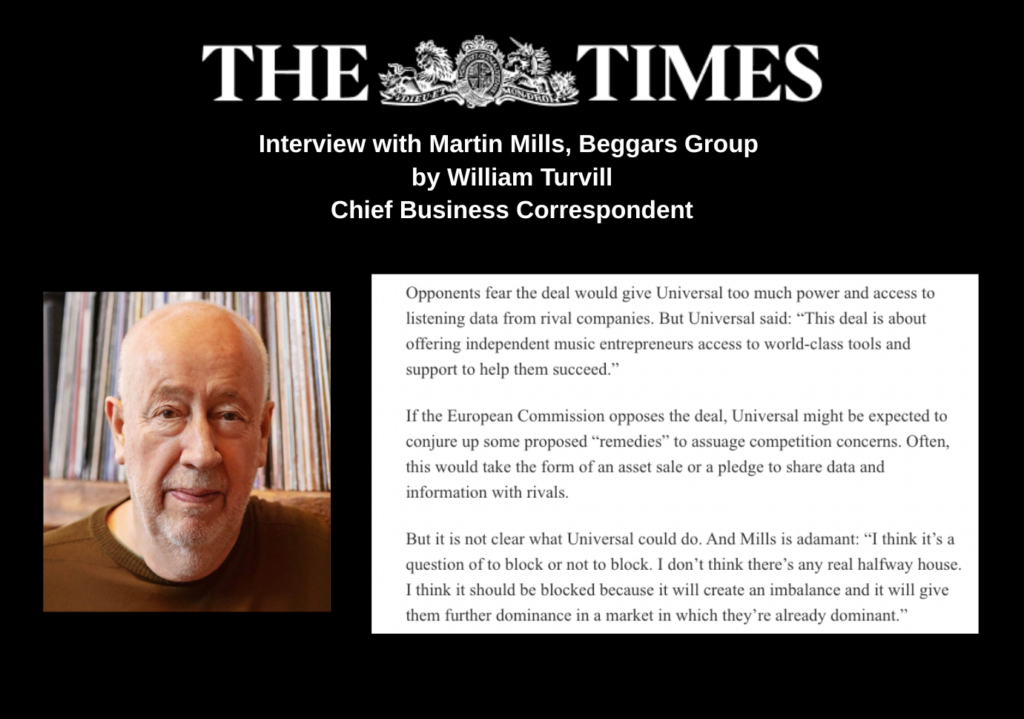
Opponents fear the deal would give Universal too much power and access to listening data from rival companies. But Universal said: “This deal is about offering independent music entrepreneurs access to world-class tools and support to help them succeed.”
If the European Commission opposes the deal, Universal might be expected to conjure up some proposed “remedies” to assuage competition concerns. Often, this would take the form of an asset sale or a pledge to share data and information with rivals.
But it is not clear what Universal could do. And Mills is adamant: “I think it’s a question of to block or not to block. I don’t think there’s any real halfway house. I think it should be blocked because it will create an imbalance and it will give them further dominance in a market in which they’re already dominant.”
It’s easy to imagine that Mills — if he had allowed Beggars to be swallowed up by a wider, US-based group — could have risen to the top of the music sector, like Grainge or Rob Stringer, the British boss of Sony Music. But he said: “I have no desire to do any of that whatsoever. Nor do I have a desire to have a pot of money in the bank.”
Mills, who started Beggars as a label for punk artists before branching into new genres and building a global staff of 250, is a music purist. “Making a profit does not come first. Putting out great music comes first.” But happily, he added: “The best way to make money in music is not to be trying to make money.”
Beggars and its five labels — 4AD, Matador, Rough Trade Records, XL Recordings and Young — have about 100 artists on their books. They benefit from their independent status. “For an artist, it’s cool to be indie,” Mills explained.
And they also seek to appeal by taking a more old-fashioned approach. While the big labels make decisions based on “analytics and data, we do it based on instinct and gut feeling”. For Beggars’ artists and repertoire (A&R) music pickers, success on Spotify and streaming platforms can be a “slight guide”; the majors, said Mills, are “far more religious” about using this data.
Although he admits that his team passed on REM and just missed out on signing Arctic Monkeys before their peak, Beggars has a strong track record and an impressive roster of artists. Through XL Recordings, in which Beggars holds a 50 per cent stake, the company scored big successes with the Prodigy and Radiohead.
But Adele, who signed a three-album deal with XL before leaving amicably for Sony, blew all others out of the water. “We signed her [based on] two tracks, on not a ridiculous deal, a fairly sensible deal,” said Mills, inferring that Beggars’ take from Adele’s work was better than would usually be the case for a global star.
“It was pretty apparent pretty quickly that there was a certain magic to her,” he said. “There was no stopping her. Most records are hard work to a greater or lesser degree; that was not hard work at all.”
In Beggars’ latest annual report, for 2023, the company reported revenues of £103 million, and Mills estimates that Adele’s first three albums accounted for more than 15 per cent of this total.
Asked whether he thought he would ever land another Adele, Mills said: “I don’t think anyone’s ever going to have another Adele. We’ve sold 30 million albums of 21 and 25. Even Taylor Swift at her peak today is nowhere near that. I don’t think it’s ever going to happen again.”
Mills, whose two children work in the business, has started to plan for a Beggars future without him. He will not divulge the details, but said confidently: “This company will remain independent for a long time after me.”
Asked when he plans to hand over the reins, he said: “One day when I’m standing at some grotty pub somewhere in east London and I fall over dead.”
