
MUSIC SECTOR WELCOMES EUROPEAN PARLIAMENT’S AGORAEU DRAFT REPORT
Brussels, 2 June 2026
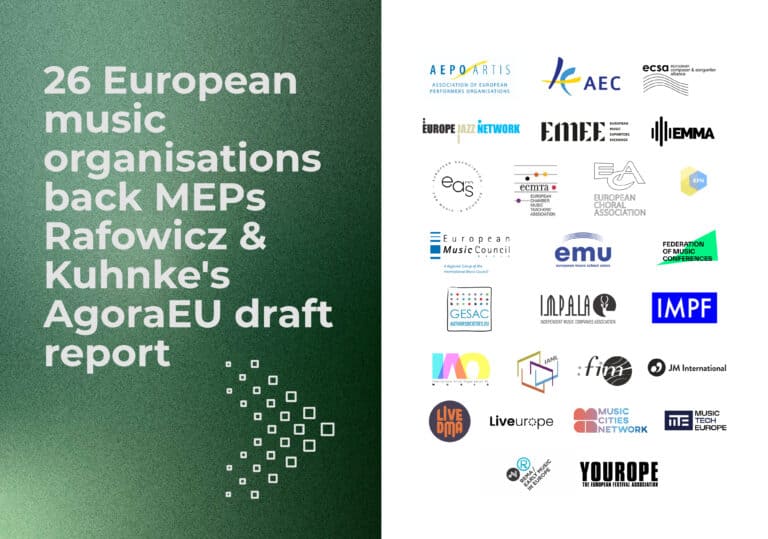
IMPALA co-signed the following statement, signed by 26 European music organisations, welcoming the draft European Parliament report on AgoraEU proposing to introduce a dedicated music strand.
26 organisations from across the European music sector welcome the draft report by MEP Rafowicz and MEP Kuhnke, and its recognition of music as a dedicated strand within AgoraEU. The proposed Culture – Music strand is a significant step forward and responds to a long-running ask from the sector for targeted support that reflects music’s economic, cultural and social weight as well as its specific structure and challenges.
The report rightly identifies several key priorities: the need to strengthen the sustainability, competitiveness and independence of the music sector; the importance of a European Music Observatory; the challenges of market concentration, digital platforms and AI; the need to prioritise human creativity and improve working conditions, fair remuneration and social protection for artists and cultural and creative professionals, and strategic questions around discoverability, access to finance, diversity, inclusion and cross-border circulation.
To make this progress meaningful, recognition must be matched with investment. Earmarking for music 15% of the financial envelope allocated to the Culture – Creative Europe, Culture – Music and Culture – MEDIA strands, as proposed by the draft report, is an essential milestone and a welcome starting point. However if AgoraEU is to help European music grow, circulate and compete internationally, this must be treated as a floor, not a ceiling.
The case for a dedicated music action is clear. Music is one of Europe’s most widely accessed and internationally visible cultural forms1, but it operates through a complex and fragile value chain made up largely of independent artists, micro, small and medium-sized actors. The sector faces specific structural pressures, including market concentration, opaque streaming systems, limited cross-border circulation, fragmented markets, AI disruption, administrative barriers and unequal access to data and finance.
At the same time music significantly contributes to the vitality, inclusiveness and cohesiveness of our societies. Cross-border European collaboration via artistic, educational and social music practices shape a democratic, cultural and resilient Europe. A dedicated music action is therefore a necessary response to clear market failures, policy gaps and uneven cultural opportunities to complement the needed policy initiatives at EU level for the achievement of those objectives.
Structured dialogue with the sector should sit at the heart of the music strand, with the European Music Observatory and future data work directly informing policy, programme design and annual calls. This will help ensure that AgoraEU continues to respond to real needs across the music sector.
Finally, we support the proposal to include digital fines as an additional source of funding for AgoraEU. Redirecting fines from breaches of EU digital legislation could bring extra resources into the programme without increasing pressure on Member State contributions, and is especially relevant given the exposure of creators, artists and music professionals to platform dominance, AI disruption and digital market imbalances.
AgoraEU can help support a stronger, more sustainable future for European music. We call on EU institutions to build on this progress during the negotiations and ensure the music strand has the funding, sector dialogue and practical tools needed to deliver long-term support.
Signatories:
- AEPO-ARTIS
- Association Européenne des Conservatoires, Académies de Musique et Musikhochschulen
- ECSA – European Composer and Songwriter Alliance
- EJN Europe Jazz Network
- European Music Exporters Exchange
- European Music Managers Alliance
- European Association for Music in Schools
- European Chamber Music Teachers Association
- European Choral Association
- European Folk Network
- European Music Council (EMC)
- European Music School Union
- Federation of Music Conferences
- GESAC
- IMPALA – Independent Music Companies Association
- IMPF, the global trade body for independent music publishers
- International Artist Organisation (IAO)
- International Association of Music Libraries, Archives and Documentation Centres
- International Federation of Musicians
- Jeunesses Musicales International
- LiveDMA
- Liveurope – The live music platform for new European talent
- Music Cities Network
- Music Tech Europe
- REMA
- YOUROPE e.V. – The European Festival Association
1 Music contributes significantly to Europe’s economy: Across EU 27 and UK it contributes €81.9 billion in gross value added to the GDP, provides direct employment for more than 1.3 million people across the EU (15% of total jobs in the cultural and creative sectors) and generates €9.7 billion in export revenue. [Source]
About IMPALA
IMPALA was established in 2000 and now represents over 6000 independent music companies in Europe. 99% of Europe’s music companies are small, micro and medium businesses and self-releasing artists. Known as the independents, they are world leaders in terms of innovation and discovering new music and artists – they produce more than 80% of all new releases and account for 80% of the sector’s jobs. IMPALA’s mission is to grow the independent music sector sustainably, return more value to artists, promote diversity and entrepreneurship, improve political access, inspire change, and increase access to finance. IMPALA works on a range of key issues for its members and started a new co-funded work programme as an EU cultural network in 2025. IMPALA runs various award schemes and has a programme aimed at businesses who want to develop a strategic relationship with the European independent sector – Friends of IMPALA. This year we are celebrating our 25th anniversary with a series of interviews Faces of the Independent Sector and other features, see more here.
