
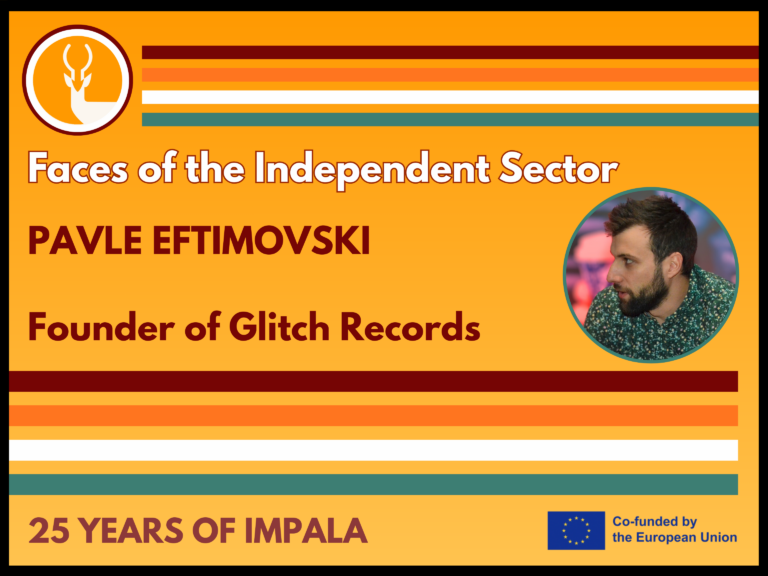
PAVLE EFTIMOVSKI, FOUNDER OF BELGRADE-BASED GLITCH RECORDS DISCUSSES HOW INDEPENDENCE MEANS HE CAN MAKE HIS OWN KEY DECISIONS IN THIS MONTH’S EDITION OF IMPALA’S ‘FACES OF THE INDEPENDENT SECTOR’
Brussels, 27 February 2026
As part of IMPALA’s Faces of the Independent Sector storytelling campaign, co-funded by the European Union, and celebrating our 25th anniversary, we are publishing the third interview in the series with Pavle Eftimovski, founder of Belgrade-based label, Glitch Records.
Across 10 questions, Pavle shares how he began his career in the music industry, from managing bands to organising festivals and concerts and running an online record store. He reflects on how independence means being able to keep as many key decisions as possible in his own hands. Pavle also talks about visibility and competition on digital platforms, challenges of AI as well as his future plans. He highlights RUNDA Digital Day, which brings together the European independent sector in the Balkans region, as well as initiatives such as the CEE Independent Music Academy, aimed at supporting the next generation of music professionals across Central and Eastern Europe.
- What do you do in the music sector?
“I’m the founder of Glitch Records, a Belgrade-based record label, where my main focus is developing emerging artists. But working in the music scene here usually means wearing multiple hats, so in addition to running the label, I also organise concerts and manage an online vinyl shop. Being a member of IMPALA through RUNDA has allowed me to connect with the wider independent sector, so we can together advocate for independent music on a regional and European level.”
- How did you start working in the music sector?
“I started out by managing a friend’s band. What began as something informal gradually became more serious, and at one point I had to decide whether to step away from it or fully commit and go professional. I chose to commit.”
- What does being independent mean to you?
“I’m very aware that in the music industry the cards are often already dealt and the rules of the game are largely defined. Being independent, for me, doesn’t mean pretending those structures don’t exist. It means keeping as many key decisions as possible in our own hands. It’s about creative freedom first of all, releasing music because we truly believe in it, not because it fits a trend or a market formula. At the same time, independence allows us to think long term. We’re building something sustainable, step by step, rather than chasing quick wins.”
- What are the biggest opportunities for the independent sector today?
“One of the biggest opportunities for the independent sector today is the ability to connect directly with audiences without relying exclusively on traditional gatekeepers. Digital platforms give independent artists and labels tools to release music, build communities, and test ideas in real time. There’s also a growing appetite among listeners for authenticity and diversity. People want music that isn’t just shaped by mainstream trends.”
- What are the biggest challenges for the independent sector today?
“The biggest challenge for the independent sector is visibility. Even though digital platforms have opened access, they’ve also created enormous competition. It’s harder than ever to stand out in a saturated market. This is especially true with the latest rise of AI tools in music creation.”
- What change would you like to see in the music industry?
“The industry has given too much power to very few hands, which limits opportunities for emerging artists and independent labels. I would like to see stronger competition and more market regulation to level the playing field.”
- What tips would you give to others starting out in the independent sector?
“Be prepared for a long and exhausting marathon. At the same time, don’t forget to Enjoy the Ride.”
- Describe the independent sector in one word.
“Diverse”
- What are the key projects or priorities you will be working on over the next 12 months that you would like to highlight?
“Over the next 12 months, I will be focusing on a few key projects. First, organising the RUNDA Digital Day, which will once again bring together professionals from the independent sector to share knowledge and explore new opportunities. Second, the CEE Independent Music Academy, which aims to support young and innovative people in gaining knowledge and connecting with the independent music sector. Personally, my focus will be more on live music, promoting and organising festivals and concerts.”
- What’s on your playlist?
My list changes almost daily, so I’ll share some songs and artists that consistently end up on my yearly top lists:
- Morcheeba – Enjoy the Ride
- Zero 7, Jose Gonzales – Today
- Air – All I Need
- Imany – Slow Down
- Pink Floyd – High Hopes
- Massive Attack – Teardrop
- Thievery Corporation – Sweet Tides
- Morcheeba – The Sea
- MARO – oxala
- Gibonni – Drvo
Click here to listen to Pavle’s full playlist on Spotify.
Check out previous editions with Merlin’s Shrina Patel and ANMIP’s Kristiyana Georgieva.
About Faces of the Independent Sector
As part of IMPALA’s 25th anniversary, the Faces of the Independent Sector spotlights the creativity and the diversity of the European independent music companies and shares the stories from the perspectives of owners, employees, and other key players. By highlighting their successes, struggles, and day-to-day realities, the campaign reveals the sector’s leaders and the stories that make it thrive. This project is co-funded by the European Union.

About IMPALA
IMPALA was established in 2000 and now represents over 6000 independent music companies in Europe. 99% of Europe’s music companies are small, micro and medium businesses and self-releasing artists. Known as the independents, they are world leaders in terms of innovation and discovering new music and artists – they produce more than 80% of all new releases and account for 80% of the sector’s jobs. IMPALA’s mission is to grow the independent music sector sustainably, return more value to artists, promote diversity and entrepreneurship, improve political access, inspire change, and increase access to finance. IMPALA works on a range of key issues for its members and started a new co-funded work programme as an EU cultural network in 2025. IMPALA runs various award schemes and has a programme aimed at businesses who want to develop a strategic relationship with the European independent sector – Friends of IMPALA
