Brussels, 28 May 2026
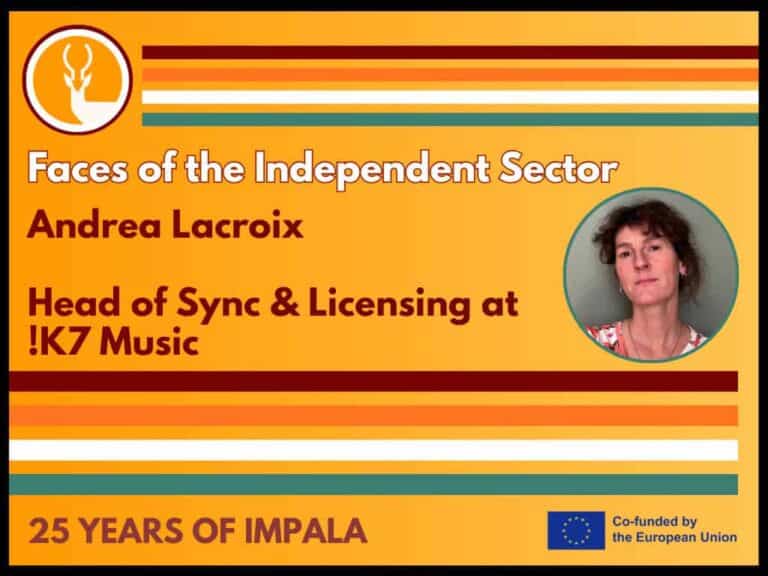
As part of IMPALA’s Faces of the Independent Sector storytelling series, co-funded by the European Union, and celebrating our 25th anniversary, we are publishing the sixth interview in the series with Andrea Lacroix, Head of Sync and Licensing at !K7 Music.
In the interview, Andrea describes her background promoting DJs and producers in the French House music scene before moving to Berlin to work in licensing and synchronisation with !K7 Music. She speaks about the importance of the independent sector, its willingness to take artistic risks, run businesses based on values it truly believes in, and its ability to work collectively on the major issues facing the music ecosystem.
As European Diversity Month comes to a close, Andrea spotlights !K7’s work on equity, diversity and inclusion (EDI) and sustainability, while outlining the pioneering work in these areas carried out by the late Horst Weidenmüller, CEO and founder of !K7 music and founder of IMPALA’s sustainability task force. Andrea also stresses how EDI and sustainability are becoming real business drivers rather than communication exercises, and how the values of the independent sector align with audiences increasingly looking for authenticity, depth and cultural diversity.
- What do you do in the music sector?
“I am responsible for the licensing and synchronisation business for the !K7 label group and the labels and artists we represent along with my team across Berlin and New York.
!K7 is a multi-faceted independent music group that provides global marketing, sales and distribution, synchronisation and licensing services to a like-minded group of labels from around the globe including Gondwana, Luaka Bop, International Anthem, R&S, Rush Hour, We Jazz, Turbo, Planet E, Sonar Kollektiv and more.”
- How did you start working in the music sector?
“Music has always played an important role in my life. I always knew that I wanted to work in the music industry one day. I gained my first experience in the promotion sector at events, followed by a role as a promoter at a booking agency that exclusively represented DJs and producers from the French house music scene. That is how I ended up at the French Music Export Office – now CNM (Centre national de la musique) – before I joined the !K7 team in Berlin in 2005, where I helped to expand the licensing and synchronisation division.”
- What does being independent mean to you?
“Independence means we don’t depend on major label structures, not for our funding, not for our distribution, and not for our decisions. We choose what we sign, how we work and who we work with. Independence is not the opposite of scale. It is the precondition for freedom with responsibility, believing in the music we release, taking artistic risk, for building long-term relationships with artists, and for running our business according to values we truly believe in. That is also why we have become a B Corp certified, something I am very proud of, as it aligns with my personal values.”
- What are the biggest opportunities for the independent sector today?
“Audiences are looking for authenticity, depth and cultural diversity, and that is exactly what the independent sector is built to deliver. We are closer to artists, faster on new formats and genres, and more willing to take a creative bet. The second big opportunity is values: equity, diversity and sustainability are becoming real business drivers, not communication exercises. Independents that take this seriously will attract the best talent, the most loyal artists and the most engaged audiences.”
- What are the biggest challenges for the independent sector today?
“Three things stand out. First, the economics of streaming still do not properly reward catalogue diversity and long-term artist development, which is the core of what we do. Second, the volume of AI-generated content and the lack of transparency around it puts pressure on human-made music and on fair remuneration. Third, scale: we have to invest in people, data, sustainability and compliance while competing with players many times our size. Collective work through IMPALA is how the sector closes that gap.”
- What change would you like to see in the music industry?
“I would like to see equity, diversity and inclusion measured the same way we are starting to measure our environmental impact. !K7’s founder Horst Weidenmüller was one of the people who brought IMPALA’s Carbon Calculator into existence, and we have seen what shared benchmarking can do for sustainability: it turns good intentions into comparable data, peer learning and real progress. We need the same for EDI. A sector-wide EDI benchmark, building on IMPALA’s charter, business case and new EDI toolkit, just launched, would give every company, from the smallest label to the largest independent, a clear baseline, a way to track progress and a way to hold ourselves accountable. That is the change I want to see, and it is something the wider !K7 team are actively pushing for. I encourage all independent businesses to fill out IMPALA’s survey and start using the toolkit.”
- What tips would you give to others starting out in the independent sector?
“Find your community early. The independent sector is generous with knowledge if you ask. Be clear about what you stand for, because that clarity is what will attract artists, partners and colleagues over time. And take EDI and sustainability seriously from day one. It is much easier to build them into how you work than to retrofit them later, and they will make you a better company in every other dimension too.”
- Describe the independent sector in one word.
“Conviction-led.”
- What are the key projects or priorities you will be working on over the next 12 months that you would like to highlight?
“I would like to highlight the following three areas:
Equity, diversity and inclusion. At sector level, Horst Weidenmüller was leading our push within IMPALA for an EDI benchmarking framework, modelled on the Carbon Calculator he helped initiate and it’s great that IMPALA has been able to get this off the ground thanks to EU funding. We are proud that Horst’s proposal has been realised, now everyone has to use it. Inside our company, we are doing the work that has to back this up. We are continuing to diversify our artist roster, particularly on !K7, 7K and Strut, where over the past two years we have actively signed more artists from the LGBTQ+ and underrepresented communities. We are also diversifying our team, hiring more career starters and people moving in from other industries and cultural backgrounds, including people who came to Berlin from war zones such as Ukraine. We employ working students (Werkstudenten) and continuously train new colleagues through Germany’s dual education system, so that young people have a real entry route into the music industry. To make sure pay is as bias-free as possible, we have introduced salary bands tied to areas of responsibility, and we deliberately keep freelancer use to a minimum in favour of permanent employment.
Sustainability. As a B Corp, we are preparing our recertification and continuing to reduce our footprint across physical production and distribution: renewable vinyl pressing, FSC-certified recycled sleeves, sea freight over air, our overstock programme to avoid vinyl destruction, and a green-powered office and servers. We also hold a seat on the board of advisors at Murmur, and we continue to drive our work within IMPALA’s Sustainability Task Force, which !K7 helped co-found.
Community and education. We are deepening our work with schools in our district in Berlin. Building on our ongoing partnership with Ernst-Reuter-Schule in Berlin Wedding, we are setting up a second partnership with another integration school in the neighbourhood, with a structured programme of company internships and apprenticeships. The goal is simple: to open a real path into the music industry for young people from communities that are usually far from it. Alongside this, we continue to invest in our labels, our catalogue and our Label Services business, with a clear focus on artist development and long-term value.”
- What’s on your playlist?
- Herbert & Momoko – Clay
- Djrum – DJ-Kicks
- Annie & The Caldwells – Can’t Lose (My Soul)
- Mykki Blanco – Stay Close To Music
- Róisín Murphy – Róisín Machine
- Lyra Pramuk – Hymnal Reworks
- Margaux Gazur – Blurred Memories
- Nídia & Valentina – Estradas
- Tricky – It’s Different When It’s Silent
- A Tribe Called Quest – People’s Instinctive Travels and the Paths of Rhythm (25th Anniversary Edition)
Listen to Andrea’s full playlist on Spotify.
Check out previous editions of the series with Merlin’s Shrina Patel, ANMIP’s Kristiyana Georgieva, Glitch Records’ Pavle Eftimovski, STOMP’s Luciano Winter and FÉLIN’s Céline Lepage.
About Faces of the Independent Sector
As part of IMPALA’s 25th anniversary, the Faces of the Independent Sector spotlights the creativity and the diversity of European independent music companies and shares the stories from the perspectives of owners, employees, and other key players. By highlighting their successes, struggles, and day-to-day realities, the campaign reveals the sector’s leaders and the stories that make it thrive. This project is co-funded by the European Union.